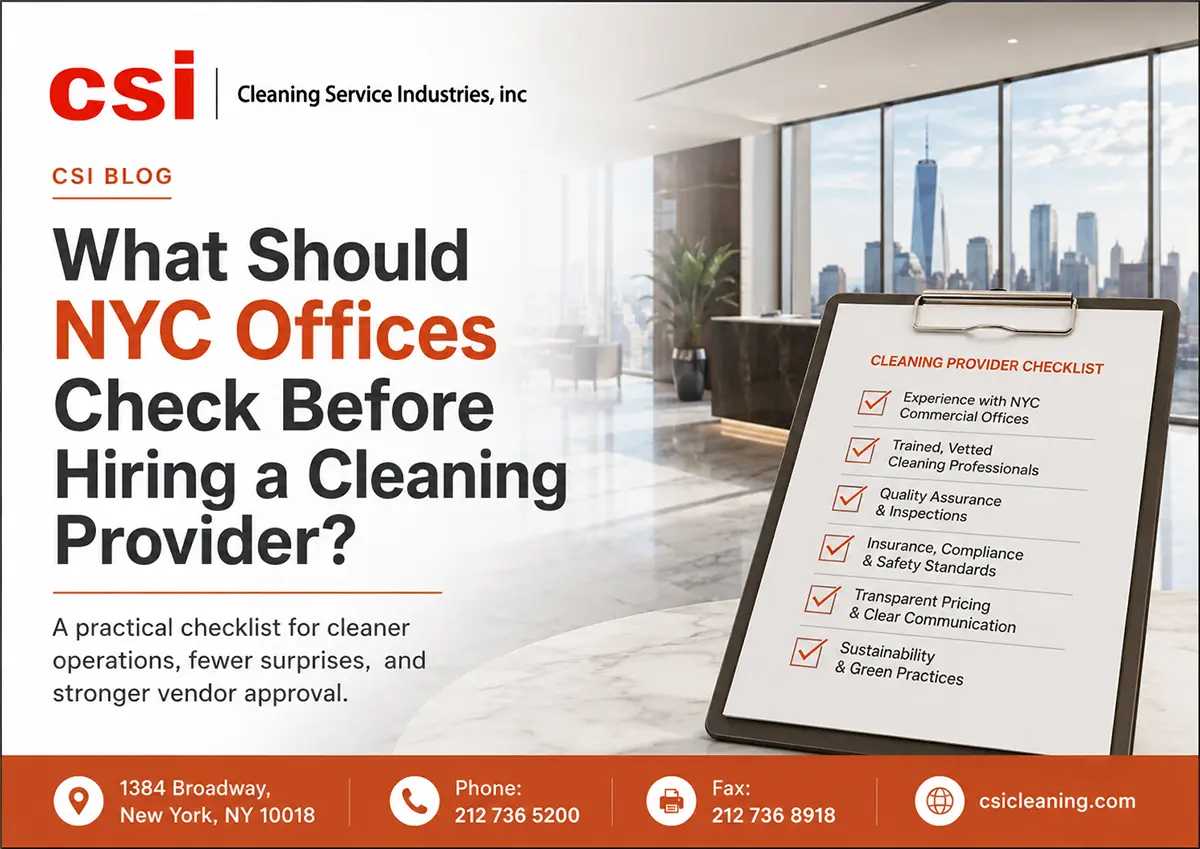
What Offices Should Use Before Hiring a Provider
Hiring a commercial office cleaning company in NYC should never start and end with price. A low bid means little when restrooms stay messy, trash gets missed, pantries smell, staff complains, or no one knows who owns the problem after service starts. The better question is whether the provider has a clear process for the day-to-day issues your office already handles. That process should be easy to review before you approve a contract or renew service.
This checklist is for people who face the real consequences of poor cleaning: office managers, property managers, facilities teams, procurement teams, and business owners. These teams need clean restrooms, reliable trash removal, clear after-hours access, visible accountability, and fewer repeat complaints. They also need a cleaning company that documents what it will do and how it will correct problems. A cleaner office starts with better questions before service begins.
Buyer Concern |
What It Means |
What to Ask Before Approval |
Restroom complaints |
Cleaning quality affects staff comfort and visitor impression. |
Which restroom tasks happen each visit, and who checks missed items? |
Pantry odors or residue |
Food areas create complaints fast and also attract pests. |
Which pantry surfaces, trash areas, and shared items are included? |
Missed trash |
Small misses become daily frustration in dense offices. |
How are trash routes, liners, and overflow areas handled? |
After-hours access |
Crews miss areas when rooms, elevators, or alarms block entry. |
What happens when access is denied, or a room is restricted? |
Repeated complaints |
Quality problems stall when no one owns follow-up. |
Who receives the issue, confirms correction, and manages repeats? |
The strongest provider is not always the provider with the longest proposal. The stronger provider explains the scope, access rules, product information, inspection process, and escalation path in plain language. Your team should be able to compare the written agreement against real office problems. If the proposal does not answer those problems, the contract needs more work before approval.
What NYC Offices Should Check Before Hiring a Commercial Cleaning Company
The first item to check is whether the cleaning company explains the work clearly in writing. General promises like “full office cleaning” or “complete janitorial service” are not enough for a busy NYC office. Your office needs a written scope with areas, tasks, and frequency. The scope should leave less room for assumptions after the first cleaning visit.
A clear scope should show what happens in restrooms, pantries, conference rooms, reception areas, workstations, private offices, trash areas, and shared spaces. It should also explain which tasks happen daily, weekly, monthly, or only by request. This matters because most cleaning problems come from mismatched expectations. One person expects appliance handles to be wiped every night, another expects desk surfaces to be left alone, and another expects interior glass to be included.
- Confirm every recurring area in the office is named in the scope.
- Confirm cleaning frequency for each major area instead of relying on one broad promise.
- Confirm which tasks need separate approval, added labor, or special scheduling.
- Confirm who receives service complaints and who confirms completed corrections.
- Confirm the start date, service days, service window, and after-hours access rules.
These checks help the office and the provider start from the same operating standard. They also make complaints easier to judge later because the team has something specific to compare against. Without this level of detail, every missed item becomes a debate about what the provider meant to include. Clear scope language protects the office, the cleaning company, and the relationship between both sides.
What Should Be Included in the Cleaning Scope?
A commercial office cleaning scope should be specific enough to answer common staff complaints. If employees complain about bathrooms, trash, dust, fingerprints, or kitchen odors, the scope should show whether those items are included. The scope should also show how often each area receives attention. That makes the document useful for daily management, not only for contract filing.
For many NYC offices, recurring cleaning needs usually fall into predictable areas. Restrooms need consistent cleaning and supply checks because complaints appear quickly when service slips. Pantries and break rooms need close attention because residue, odors, trash, and crumbs create bigger issues. Reception areas, conference rooms, and visible glass affect how visitors and staff judge the workplace.
Office Area |
Common Issue |
Scope Language to Confirm |
Restrooms |
Odors, supply gaps, fixtures, trash, floors, mirrors. |
Tasks, frequency, supply-adjacent responsibilities, and issue reporting. |
Pantries and break rooms |
Food residue, trash overflow, appliance handles, sink areas. |
Included surfaces, trash handling, floor care, and boundaries around appliances. |
Conference rooms |
Table marks, trash, fingerprints, whiteboards, floor debris. |
Post-meeting reset tasks, schedule, and limits around personal or business materials. |
Reception and lobby areas |
Visible dust, fingerprints, mats, floors, glass, trash. |
Daily visible-area expectations and high-priority appearance standards. |
Workstations and private offices |
Dust, bins, floors, personal items, electronics. |
What crews clean, what they avoid, and how desk restrictions are handled. |
The scope should also define what constitutes outside routine service. Specialty floor restoration, post-construction cleaning, pest control, deep carpet cleaning, interior appliance cleaning, tenant project work, and event cleanup often need separate planning. Those services might still belong to the same provider, but they should not be hidden behind vague nightly-cleaning language. Separate approval keeps the recurring office cleaning agreement clear and enforceable.
Check Insurance, Workers’ Compensation, and Bonding Claims
Before approving a commercial office cleaning provider, ask for current documentation. Your internal team should review the certificate of insurance and workers’ compensation information. If the provider says employees are bonded, request documentation supporting that claim. A verbal statement is not enough for a commercial office, property team, ownership group, or procurement file.
This does not mean the office manager becomes a legal reviewer. It means the provider gives your internal reviewer, landlord, property manager, or ownership group the documents they expect to see. The company name, effective dates, coverage categories, and building-specific requirements should match the approval process. The provider should also explain who sends updated documents when current documents expire.
- Request the current certificate of insurance before approval or renewal.
- Request workers’ compensation documentation before crews begin work.
- Request bonding documentation if the provider claims bonded employees.
- Check whether the named company matches the proposal and contract.
- Confirm who sends updated documents before expiration dates create gaps.
These items matter because cleaning work often happens after hours and outside normal staff oversight. The office needs documentation before the work starts, not after an incident or complaint. If the provider includes a coverage claim in the proposal, it should support it with current documentation. If required documents are missing, pause the approval until the packet is complete.
Make After-Hours Access Rules Clear
Many NYC offices rely on cleaning crews after business hours. That creates a simple operational problem: the crew cannot clean what it cannot access. Locked doors, elevator limits, alarm problems, restricted rooms, late meetings, and unclear authorization all lead to missed work. These issues should be documented before service starts.
The cleaning company should know who authorizes entry, which doors or elevators to use, which rooms are restricted, what to do when a space is locked, and who receives the report when access blocks the work. This prevents confusion later because the provider has a written rule for common night-work problems. It also protects restricted rooms from accidental entry. When access rules stay verbal, the next supervisor or crew often inherits incomplete instructions.
Access Situation |
Risk If Not Defined |
Better Operating Rule |
Locked pantry or office |
Crew skips the area and staff assume poor service. |
Provider reports denied access to the named account contact. |
Restricted room |
Crew enters a space that should remain off-limits. |
Restricted spaces appear in the scope and access instructions. |
Late meeting in conference room |
The room is missed and the next morning starts with complaints. |
Provider follows the agreed missed-room reporting process. |
Alarm or badge issue |
Night crew loses access and work remains incomplete. |
The escalation contact and backup access procedures are documented. |
Elevator or freight access limit |
Trash routes and floor access become inconsistent. |
The service window and building access process are confirmed before the start date. |
After-hours rules also help separate service failure from access failure. If a room is locked, the issue is different from that of a missed task in an open room. Your team needs that distinction when reviewing complaints. A provider with a clear reporting process makes that distinction easier to manage.
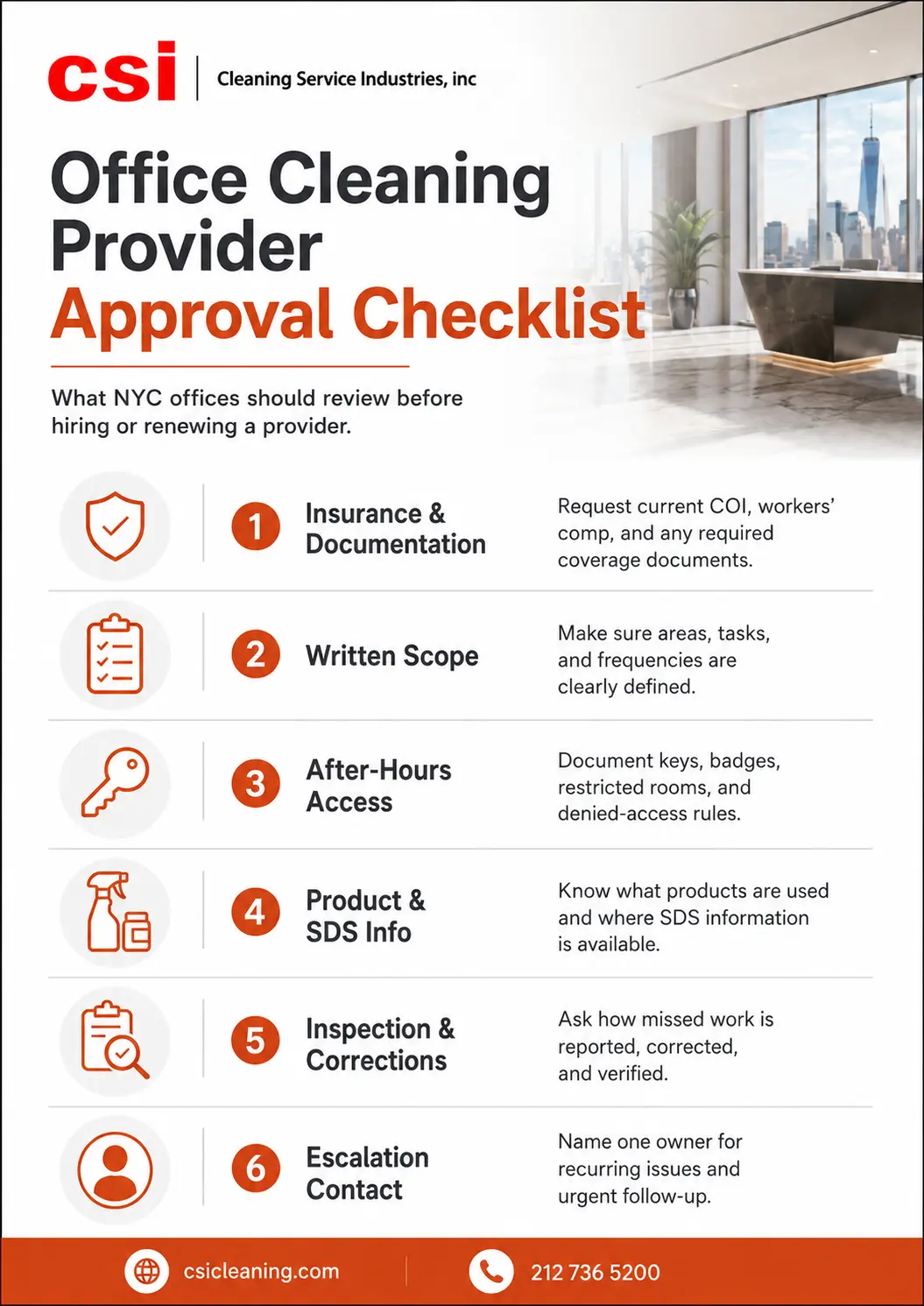
Define High-Touch Cleaning Before Complaints Start
High-touch cleaning means different things to different people. One office expects door handles, elevator buttons, light switches, conference tables, reception counters, and pantry handles. Another office expects desk phones, chair arms, shared equipment, appliance handles, and printer areas. The provider should not guess, and the office should not assume.
Before hiring a provider, define the included touchpoints and how often they receive attention. A high-traffic NYC office might need more attention in restrooms, pantries, reception areas, conference rooms, and shared equipment zones. A smaller office with fewer visitors might need a lighter routine. The right answer depends on how the space is used, not on generic wording in a proposal.
- Door handles and push plates
- Reception counters and visitor-facing surfaces
- Conference room tables and chair touchpoints
- Pantry handles, counters, sinks, and shared surfaces
- Restroom touchpoints, fixtures, partitions, and dispensers
- Shared equipment areas such as printers and copy stations
- Elevator-adjacent surfaces when included in the office scope
This level of detail reduces repeat complaints because everyone knows what high-touch cleaning includes. It also helps the provider train the crew for the specific space rather than using a generic routine. If a touchpoint matters to staff or visitors, it belongs in the written expectation. If it is not included, the office should know that before complaints begin.
Ask How Inspections and Corrections Work
A cleaning company should have a process for checking work and correcting missed tasks. Ask how inspections work, who performs them, and how your team reports problems. The answer should not rely on vague promises about good service. It should explain what happens when something is missed.
The first 90 days matter most because the provider is learning the space, staff is observing changes, and the scope is being tested in real-world office use. Early problems do not always mean the provider is wrong for the account. They do mean communication and correction need structure. Without a correction process, every complaint becomes a separate argument.
Question to Ask |
Why It Matters |
Strong Answer Looks Like |
Who receives complaints? |
Issues stall when they go to the wrong person. |
Either a named account contact or a service channel owns intake. |
How are corrections confirmed? |
Staff loses trust when fixes are invisible. |
The provider confirms completion and notes repeat issues. |
What happens with repeated complaints? |
Recurring misses need account-level attention. |
The escalation owner reviews pattern, staffing, access, and scope. |
How are inspections handled? |
Quality drops when no one checks the work. |
Inspection expectations are defined for the account. |
How are scope changes handled? |
Extra work creates conflict when not approved. |
New work is priced, approved, and added to the scope separately. |
A clear correction process helps the office move from complaint to resolution faster. It also helps the provider identify whether the issue is crew performance, unclear scope, denied access, staffing, or a special request outside routine service. The best process is simple enough for the office team to use without extra friction. The provider should make accountability easier, not harder.
Name One Escalation Contact
Every commercial office cleaning account needs one clear escalation owner. This does not mean every issue goes to a senior executive. It means your team knows who owns the account when normal communication fails. Without that person, repeated complaints often move between inboxes without resolution.
The escalation contact should handle repeated complaints, scope questions, staffing concerns, access issues, and quality concerns. This person should also know the account history and understand the building rules. A general phone number is useful for routine communication, but it does not replace ownership. One accountable contact keeps small issues from becoming ongoing management problems.
- Repeated restroom or pantry complaints
- Missed trash on specific floors or departments
- Access problems caused by locked rooms, alarms, or building rules
- Questions about whether a task is included in the scope
- Staffing or schedule concerns affecting service consistency
- Correction items that were reported but not closed
This part of the review is simple but important. Ask who owns the account after service begins. Ask how that person receives escalations and how repeated problems are tracked. If the provider cannot answer clearly, the office should clarify accountability before signing.
What to Request Before You Approve or Renew Service
Before approving or renewing a commercial office cleaning provider in NYC, request one clear vendor packet. The packet should provide your team with the documents and operational details needed to review the provider with confidence. It should also give the cleaning company a clear standard to follow after work begins. The right provider should welcome this level of clarity because it protects both sides.
- Current certificate of insurance
- Workers’ compensation documentation
- Bonding documentation if bonded employees are claimed
- Written cleaning scope by area and frequency
- After-hours access instructions
- Restricted-room rules
- SDS access information
- High-touch cleaning expectations
- Inspection and correction process
- Named escalation contact
This packet gives your office a stronger starting point than price alone. It also helps your team compare providers more fairly because each company is responding to the same expectations. When the scope, documents, access rules, and correction process are clear, daily service becomes easier to manage. That is the real value of a practical commercial office cleaning checklist.
Keeping Your Commercial Space Clean with Help from the Best
Commercial office cleaning in NYC works best when the provider, office team, and property team agree on the details before service begins. Price matters, but it should not replace documentation, clarity of scope, access rules, product information, inspections, and accountability. These items affect how the office looks, how staff feels, and how quickly problems get fixed. They also reduce avoidable disputes after the contract starts.
Before hiring a provider, ask for the paperwork, define the scope, confirm access rules, and name the person responsible for corrections. Those steps help prevent the most common cleaning complaints before they become daily distractions. A clean office is not only the result of nightly work. It starts with a better approval process before the first crew arrives.
