Commercial Facility Operations and the 90-Day Performance Drop
Why do commercial corporate office cleaning standards consistently deteriorate three months after executing a new janitorial service agreement? In high-density corporate environments, securing consistent commercial office cleaning New York City requires partnering with institutional providers that deploy 100% direct W-2 labor, enforce strict 1:10 on-site supervisor ratios, and back performance with enforceable contractual SLA invoice holdbacks. Across Manhattan office towers, facility managers frequently experience a sharp decline in cleaning quality after an initial honeymoon phase. Understanding the labor economics of vendor margin extraction, recognizing the physical indicators of facility neglect, and embedding objective digital quality audits into service agreements protects commercial office assets from creeping operational decay.
When commercial facility executives sign a new cleaning contract, the initial sixty days typically proceed smoothly. Vendors assign their most polished onboarding crews to deep-clean high-traffic zones, polish tile grout, and secure client approval during the probation period. However, once the contract passes the ninety-day threshold, senior personnel are quietly reassigned to newer accounts, leaving the property to unmonitored entry-level workers. Frontline cleaners facing unrealistic production quotas abandon detail dusting and multi-step disinfection, leading to visible grime buildup and widespread tenant dissatisfaction.
Labor Economics Background and the Subcontractor Margin Extraction Model
The systematic quality drop observed across commercial facilities is a calculated economic reallocation rather than an operational accident. In low-bid commodity janitorial contracting, national brokerages bid aggressively low square-foot rates to win enterprise accounts. Because direct cleaning labor represents over 70% of total janitorial operating expenses, contractors cannot maintain initial staffing levels while meeting corporate profit benchmarks.
Once the client relationship enters steady-state operation, the contractor shifts the account into margin-extraction mode. Experienced supervisors and senior technicians are pulled off-site to stabilize newly signed contracts. The facility is reassigned to third-party 1099 independent subcontractors or minimum-wage labor pools. According to industry benchmarking data published by the Building Service Contractors Association International (BSCAI), annual frontline turnover in low-bid commercial janitorial operations ranges from 200% to 350%, climbing past 400% in dense metropolitan markets.
With cleaning crews turning over three to four times per year, replacement workers never develop familiarity with building security sequences, executive suite protocols, or specialized surface care. Under aggressive production quotas exceeding 5,000 square feet per hour, cleaners perform only superficial tasks like emptying central trash cans and spot-vacuuming main aisles. Detail sanitization, rotational high dusting, and chemical dwell times are completely abandoned, accelerating the visible decline of the corporate environment.
Why Low-Bid Commodity Brokerages and 1099 Subcontracting Models Fail
Corporate procurement departments mandated to minimize operational overhead often award multi-floor janitorial contracts to the lowest-bidding contractor. Relying on low-bid commodity janitorial brokerages represents an expensive administrative mistake that degrades prime real estate.
Commodity contracting models trigger systematic facility degradation across three primary operational pathways:
- Brokerage Margin Squeezing and Labor Churn: National brokerages extract 20% to 30% overhead off the top before farming accounts out to 1099 subcontractors; operating on compressed margins, subcontractors pay minimum wage with zero benefits, triggering immediate labor turnover.
- Skipped Disinfectant Chemical Dwell Times: EPA-registered quaternary disinfectants require 5 to 10 minutes of wet contact time to kill pathogens; rushed cleaners spray and immediately wipe, leaving viral and bacterial biofilms intact on high-touch surfaces.
- Re-Contamination from Saturated Equipment: Unsupervised crews reuse dirty mop water and unwashed microfiber cloths across multiple tenant floors, spreading soil, cross-contamination, and bacteria across executive suites instead of extracting them.
Facility directors who try to fix declining standards through informal email complaints find improvements last only a few days before slipping back into mediocrity. Because commodity vendors lack direct labor control, management cannot enforce permanent behavioral changes on frontline workers. Preventing service decay requires replacing verbal assurances with contractually mandated staffing models and digital auditing protocols.
Institutional Quality Assurance: ISSA CIMS Standards and Enforceable Service Agreements
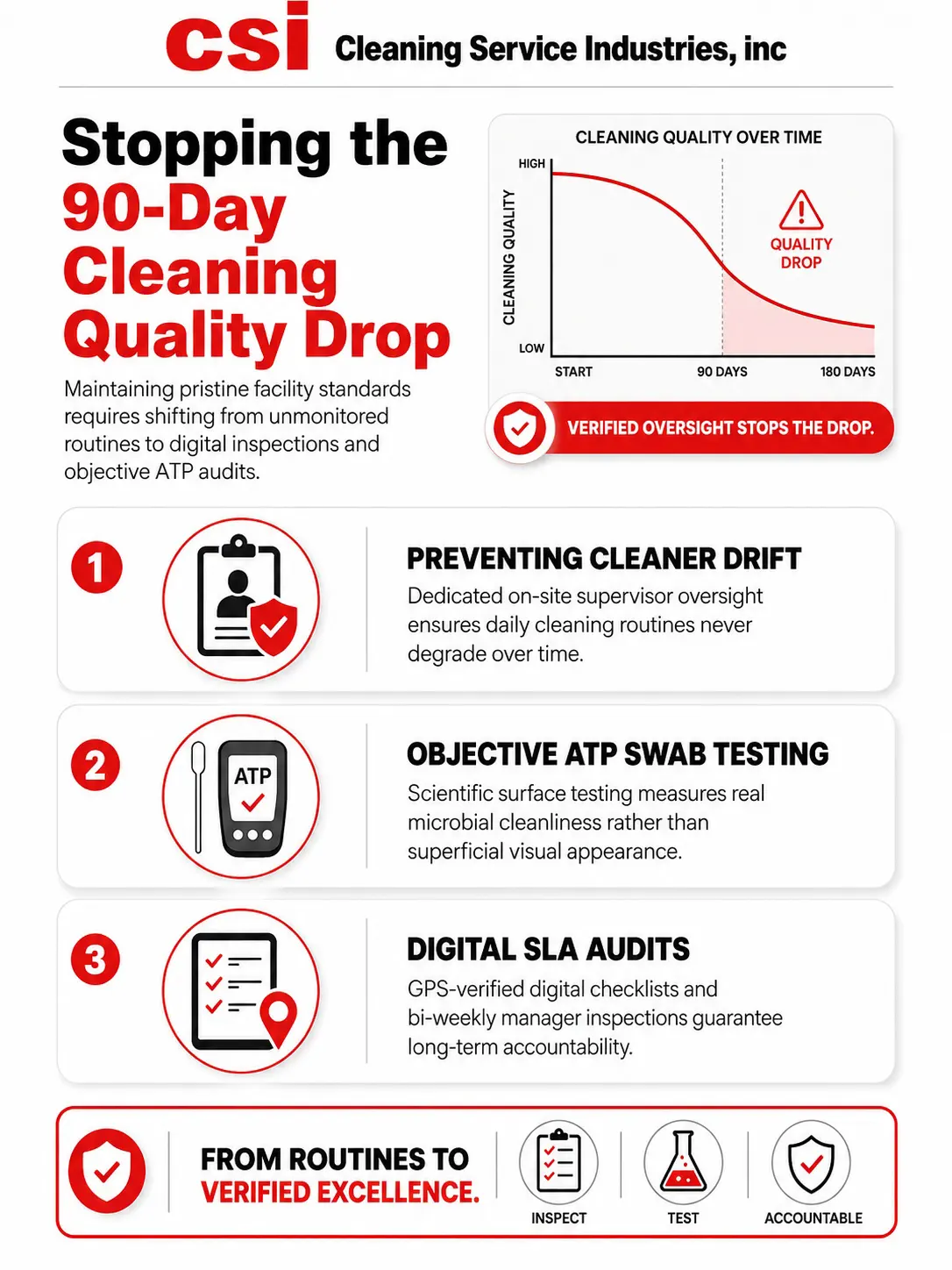
Maintaining consistent, multi-year janitorial performance requires implementing structured management frameworks aligned with the ISSA Cleaning Industry Management Standard (CIMS). Corporate facility agreements must mandate a strict supervisory ratio of not more than ten frontline cleaning technicians per dedicated on-site supervisor. The on-site supervisor must actively manage the floor during operational hours, verifying chemical dilution ratios, monitoring production pace, and inspecting work quality before building lockup.
Service agreements must also establish objective, time-stamped digital quality reporting. Supervisors must execute weekly photographic audits across all operational zones—including reception areas, executive suites, conference rooms, and restrooms—scoring cleanliness against a standardized 100-point rubric. Audit reports are transmitted directly to the facility director every Monday morning, providing transparent documentation of custodial performance.
To ensure permanent vendor accountability, contracts must include performance-tied invoice-approval remedies. The agreement must require monthly invoice authorization to maintain a rolling 30-day average audit score of 90% or higher. If inspection scores drop below this benchmark, the client enforces a 10% invoice holdback with a formal 30-day cure notice, ensuring immediate executive attention and sustained operational compliance.
Comparative Structural Analysis of Commercial Cleaning Operating Models
Operational Parameter | Low-Bid Commodity Brokerage | Institutional Facility Partner | Impact on Corporate Real Estate |
Labor Employment Model | 1099 independent subcontractors or temp labor | 100% direct W-2 employed cleaning staff | Ensures consistent personnel and accountability |
Annual Frontline Turnover | 200% to 400% annual employee churn | Substantially lower; stable career teams | Preserves facility knowledge and security protocols |
On-Site Supervision | Absent; occasional daytime drive-by checks | Dedicated on-site supervisor on floor nightly | Guarantees detail inspection before lockdown |
Quality Verification | Reactive; waits for client email complaints | Proactive weekly digital photo audits (> 90%) | Identifies micro-deficiencies before tenants notice |
Contractual SLA Remedies | Disclaimed; full monthly billing enforced | Enforceable 10% invoice holdback tied to SLA | Aligns vendor financial incentives with quality |
Field Quality Diagnostic Protocol for Commercial Office Facilities
Evaluating commercial cleaning performance objectively requires moving beyond casual visual walks to implement standardized forensic diagnostic testing. Facility directors deploy systematic quality inspection protocols to audit cleaning thoroughness and chemical efficacy. A comprehensive facility diagnostic protocol incorporates three standardized technical benchmarks.
- The Altitude Dusting Verification Scan (> 6 Feet): Supervisors inspect architectural surfaces above six feet—including conference room display tops, door headers, HVAC supply louvers, and tall acoustic dividers—confirming that rotational detail dusting is actively maintained.
- Baseboard and Perimeter Soil Metering: Specialists audit edge lines and corners using optical gloss meters and white-cloth wipe tests, detecting accumulated mop-water soil rings from hurried floor-buffing machinery.
- Adenosine Triphosphate (ATP) Bioluminescence Swab Testing: Calibrated luminometer swabs test high-touch surfaces (door handles, conference table edges, elevator call buttons), measuring organic microbial residue in Relative Light Units (RLU) to verify true biological disinfection.
Standardized diagnostic audits provide incontrovertible, empirical proof of custodial performance. Documenting quantitative ATP levels and altitude dusting benchmarks eliminates subjective disputes between property managers and service vendors. Facility executives receive verified operational data, ensuring tenant health, executive satisfaction, and pristine corporate standards.
Institutional Janitorial Excellence with CSI Cleaning
Eliminating the 90-day quality drop in New York City commercial facilities requires partnering with an institutional cleaning specialist that rejects low-bid brokerage models. Deploying a 100% direct W-2 workforce, maintaining dedicated on-site nightly supervision, and backing services with transparent digital audits ensures sustained janitorial excellence. Aligning contractual service level agreements with objective inspection metrics guarantees corporate office environments remain immaculate year after year.
Corporate Specialty Insourcing (CSI Cleaning) has delivered high-end commercial office cleaning and facility management across Manhattan and the greater New York metropolitan area for over thirty years. With comprehensive W-2 staffing, advanced ISSA CIMS-aligned quality controls, and enforceable SLA agreements, CSI Cleaning provides permanent facility security. To schedule an objective facility audit and customized service proposal for commercial office facilities, contact CSI Cleaning at (212) 658-0050.
