
Is my Office Cleaning Service in NYC Working for Me?
Quality assurance in office cleaning should mean more than a checklist signed at the end of the night. A checklist shows what was assigned, but it does not always prove the work matched the office’s expectations. NYC offices need a process for inspecting results, documenting misses, correcting problems, and spotting repeat issues before staff lose confidence in the service. That process matters most after the first few weeks, when the startup attention fades and the recurring routine begins.
For office managers, property managers, facility teams, and owners, the question is simple. Does the provider have a real process for keeping the office clean after service begins? If the answer is only “our supervisor checks the work,” the contract needs more detail before approval or renewal.
The Direct Answer
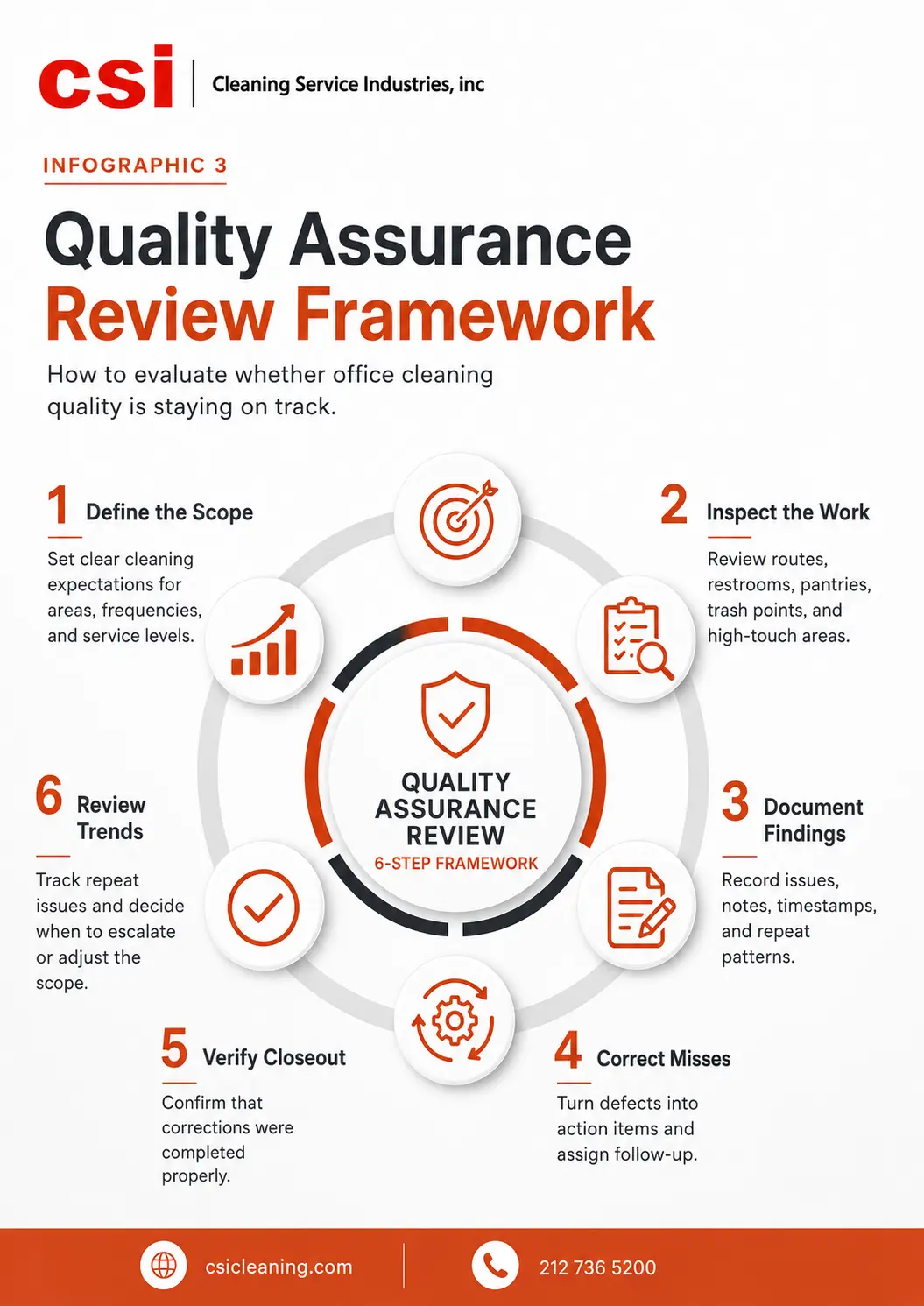
Quality assurance is the operating process behind the cleaning checklist. It should connect the written scope, cleaning routes, inspection schedule, findings, work orders, corrections, complaint tracking, escalation contacts, and periodic review. Those pieces help the office team understand whether a problem came from missed work, unclear scope, poor routing, access limits, or repeat service drift.
A provider with a strong QA process should explain who covers each route, who inspects the work, what gets documented, how defects become corrections, who verifies closure, and when repeat complaints escalate. That explanation should be practical enough for the office team to use during the contract. It should not depend on vague promises or a single supervisor’s memory.
What Quality Assurance Should Cover
The QA process should match the recurring cleaning scope. It should focus on the office areas people notice every day, including restrooms, pantries, trash points, conference rooms, reception areas, high-touch surfaces, visible fingerprints, dusty edges, and floor conditions. It should also account for after-hours access issues when locked rooms, tenant restrictions, badges, alarms, or security procedures affect the work. If the provider cannot inspect an area because access fails, the record should show that condition.
- Written cleaning scope by area and frequency
- Cleaning routes tied to floors, rooms, and service windows
- Inspection schedule and responsible supervisor or account owner
- Standards for restrooms, pantries, trash, dust, high-touch points, and visible surfaces
- Documentation method for findings, missed tasks, and open items
- Work order process for corrections
- Complaint tracking and repeat-issue review
- Escalation path for unresolved or recurring problems
- Periodic scope review when office use changes
These items turn QA into a management tool. The office team sees what gets inspected, what failed, what was corrected, and what keeps returning. Without that record, the renewal conversation depends on memory, complaint volume, and frustration rather than service performance.
A Quick Way to Test QA Strength of an Office Cleaning Service NYC
Recurring complaints reveal whether the QA process works. If the nightly checklist is complete but the same restroom, pantry, trash, or dust complaints return, the issue is not only task completion. The provider may need a better inspection route, a clearer standard, stronger correction tracking, or a scope adjustment. The office team should ask for the process behind the promise.
| Condition | What It Means | Best Next Step |
| Checklist is complete, but the same complaints return | Inspection is not confirming the actual outcome | Require documented inspection findings and closure steps |
| Low complaints, but no inspection records exist | Issues may be informal, unreported, or missed during review | Ask for trend reporting and open-item tracking |
| Supervision language is vague | Ownership, inspection timing, and reviewed areas are unclear | Identify who inspects, how often, and which areas get reviewed |
| Pantry or restroom misses repeat | The route, schedule, or scope may not match the space | Trigger a route, scope, and correction review |
| Access rules are missing from QA records | After-hours inspection may be incomplete | Document badges, alarms, restricted areas, and denied-access reporting |
| No escalation owner is named | Repeat defects may stall instead of improving | Set a repeat-issue threshold and account owner |
Why Quality Slips After Launch
Many cleaning contracts look strongest during startup. The provider pays close attention, communication is faster, supervisors appear more often, and early issues get handled quickly. Quality can drift after the first 90 days when routes become routine, inspections become informal, and repeat complaints get handled as one-off issues. QA should prevent that drift.
Morning complaints are often the first signal. Restroom supplies run low, pantry counters stay sticky, trash gets missed, fingerprints remain near entry points, high-touch areas feel neglected, and dusty edges become obvious. Each issue may seem small alone, but repeated misses make staff question the whole service. A strong QA process shows whether the provider is improving the pattern or only reacting to the latest complaint.
What Good QA Documentation Looks Like
Good QA documentation should be simple enough to use and detailed enough to manage. It does not need to overwhelm the office with paperwork. It should show the route, the inspected areas, the findings, the correction status, and the person responsible for follow-up. That record helps separate missed work from unclear scope language or access problems.
- Inspection notes tied to the written scope
- Issue categories such as restroom, pantry, trash, dust, floor, glass, and high-touch areas
- Work order references for missed or incomplete tasks
- Timestamps or service dates for recurring issues
- Closure status after correction
- Supervisor review notes for repeated patterns
- Photo documentation only when allowed and appropriate
- Route or scope change notes when office use changes
This record gives the office team leverage during contract management. If the same pantry complaint appears three times in one month, the answer should not be another reminder to the crew. The provider should review the route, timing, usage pattern, scope, and inspection standard. That is the difference between QA and simple complaint handling.
How to Judge QA Language Before Renewal
Strong QA language names the process clearly. It identifies the scope, route, inspection timing, documentation format, correction workflow, escalation contacts, reporting frequency, and scope review timing. It also explains how repeat issues receive a different response from one-time misses. That distinction matters because repeat restroom, pantry, trash, dust, fingerprint, and high-touch complaints usually need management review.
Weak QA language relies on broad claims. Phrases such as regular supervision, quality checks, consistent results, or supervisor review sound fine, but they do not explain how the office will know whether quality is under control. Before signing or renewing, ask the provider to explain the actual process. If they cannot answer without improvising, the QA terms are not clear enough.
| QA Language | Accept, Clarify, or Reject | Reason |
| Scope, route, inspection cadence, correction workflow, and escalation owner are named | Accept | The process gives the office team a way to evaluate performance |
| Provider says supervisors check the work, but gives no schedule or documentation method | Clarify | The claim may be true, but it is not reviewable enough |
| Complaint reporting exists, but repeat issues are not tracked | Clarify | The office needs to know whether the same problems keep returning |
| Checklist exists, but no inspection route, standard, or closure process exists | Reject or revise | The checklist confirms activity, not quality control |
| No named owner for repeated complaints | Reject or revise | Recurring issues need accountability before renewal |
Questions to Ask an Office Cleaning Service NYC Before Signing or Renewing
The best QA review happens before the contract is signed or renewed. The office team should test the provider’s process against the problems staff are most likely to notice. Restrooms, pantries, trash, fingerprints, dusty edges, high-touch areas, visible floors, and after-hours access limits should all be part of the conversation. The provider should answer in operational terms, not marketing language.
- Who inspects each route, and how often?
- Which areas get inspected against the written scope?
- Where are inspection findings documented?
- How does a missed task become a work order?
- Who verifies closure after correction?
- When does a repeat complaint escalate?
- Who owns the account when problems repeat?
- Who has authority to adjust the route or recommend a scope change?
- How often does the provider review trends with the client?
These questions make the contract easier to manage. They also help the provider understand what the office expects from the beginning. A company with a real QA process should answer them directly and place the answers in the operating scope, proposal, or contract attachment.
Final Takeaway
Quality assurance in office cleaning is not a signature on a nightly checklist. It is the process that keeps recurring service measurable, correctable, and accountable after the first weeks of service. A strong QA process defines the scope, routes, inspections, documentation, corrections, escalation path, and review rhythm. That gives the office team a fair way to judge performance.
Before awarding or renewing a recurring office cleaning contract, ask how the provider inspects work, documents issues, closes corrections, and handles repeat complaints. If those answers are specific, the service is easier to manage. If the answers are vague, clarify them before the contract begins.
Related Reading
- NYC Winter Floors: What Snow Tracks into Your Office, What It Damages, and How to Stop It
- Why an Office Cleaning Service in NYC Is a Business Requirement, Not a Preference
- Delivering Health, Productivity, and Peace of Mind with Office Cleaning Service New York
- How Office Cleaning Changes During a Heatwave (And Why It Should)
- Why Your Office Smells Weird — And What Cleaning Teams Can Do About It
