A conference room can change roles without moving a single chair. One month, it is an internal space where coffee rings, fingerprints, and a crooked cable tray are minor irritations. The next, it is where prospects wait before a pitch, partners review contracts, and clients quietly judge the company before anyone opens a deck. In a New York office, that shift turns an ordinary room into a daily brand signal.
When a conference room is client facing every day, its cleaning plan has to exceed the baseline used for the rest of the office. The issue is not just cleaning more often; it is cleaning with sharper attention to sightlines, touchpoints, seating, glass, presentation tools, and the reset between visits. Effective office cleaning New York plans should treat this kind of room according to exposure and business impact, not square footage alone. A high-visibility room needs a hospitality-level reset that protects first impressions from the moment the door opens.
Daily Conference Room Cleaning Requirements
A client-facing conference room needs a daily reset that treats every visible surface as part of the meeting experience. The table should be cleaned edge to edge, including corners, cable ports, and the areas where hands naturally rest. Chairs need attention at the arms, backs, legs, and bases, because guests touch and move them throughout the day. Floors should be checked around chair paths, table edges, corners, and the entryway, where lint, crumbs, and tracked-in debris tend to collect first.
Daily cleaning should also focus on the small contact points that clients may notice without consciously looking for them. Door handles, light switches, thermostat controls, credenza pulls, remote controls, conference phones, touchscreens, and speaker buttons should be cleaned without damaging the equipment. Glass walls, interior windows, marker boards, and framed displays should be checked for fingerprints, dust, ghosting, and splash marks. Waste should be removed even when bins are only partly full, because cups, wrappers, and paper can quickly create odor or visual clutter in a closed meeting space.
- Clean the main table, including edges, corners, and cable ports.
- Wipe chair arms, backs, visible bases, and high-touch frame areas.
- Remove fingerprints from glass, doors, switches, and handles.
- Clean remotes, phones, touchscreens, and shared presentation controls.
- Empty waste and replace liners before odor or clutter develops.
- Check floors for crumbs, scuffs, lint, and entry debris.
Odor control should be addressed as part of the room’s presentation, not masked by heavy fragrance. A daily office cleaning New York routine should remove the source first, including old beverages, food residue, damp liners, and stale air from an enclosed room. Light ventilation, careful waste handling, and clean soft surfaces help the room feel fresh without making it smell artificially scented.
Between-meeting Conference Room Reset Requirements
When clients use the room throughout the day, the reset between meetings should be treated as a presentation detail. The room may not need a full cleaning after every appointment, but it does need a quick visual recovery so the next visitor never sees evidence of the prior conversation. This matters in New York offices where meetings often stack tightly, and rooms turn over with little buffer time. The goal is for every group to enter a room that feels prepared specifically for them.
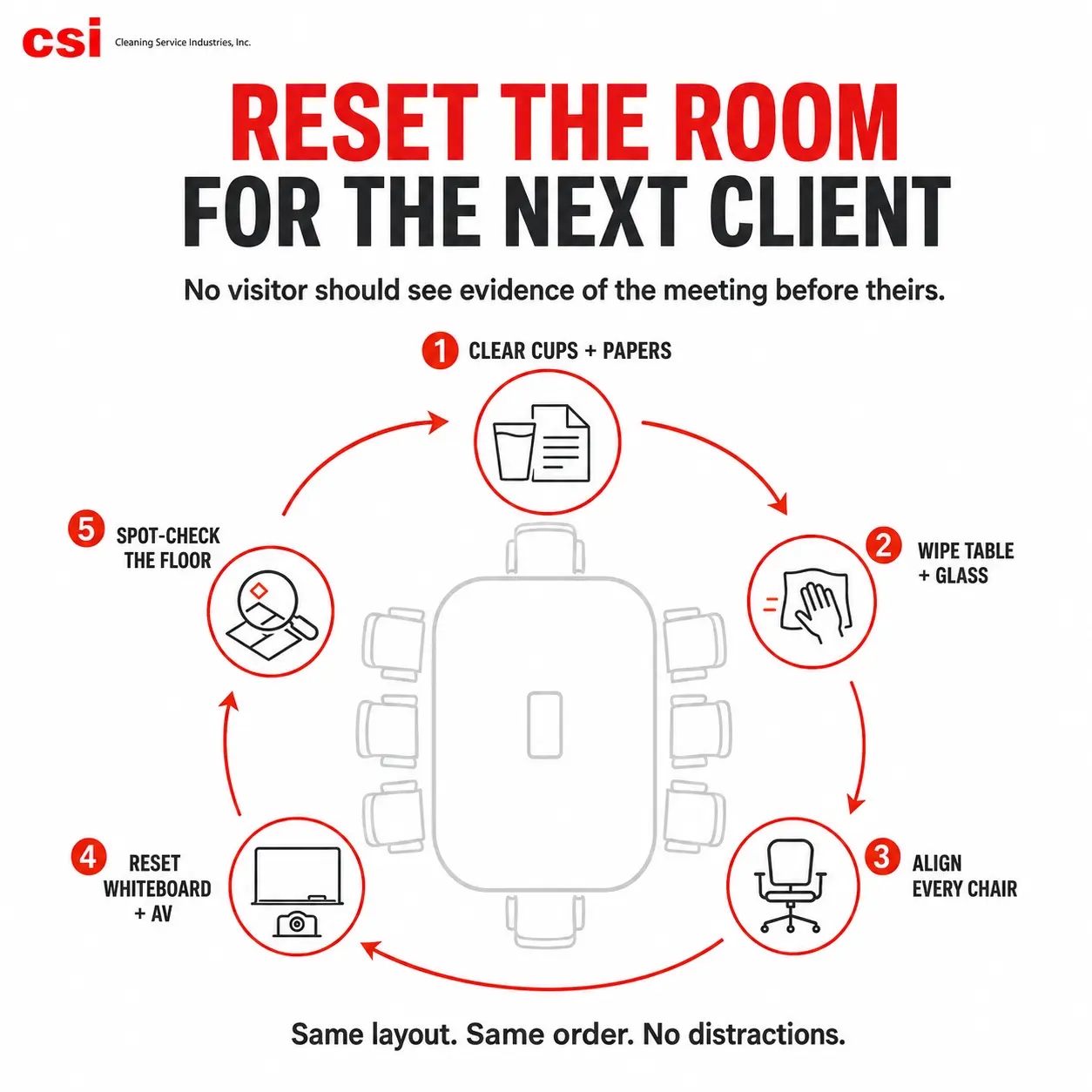
The first priority is removing anything that creates a “used” impression. Coffee cups, water bottles, napkins, catering crumbs, marked-up papers, and abandoned handouts should be cleared before the next group enters. Tabletops should be checked from the client’s seated angle, because cup rings and smudges can be more visible there than from the doorway. Chairs should return to the same spacing and orientation each time, since uneven seating makes the room look rushed even when surfaces are clean.
- Clear cups, plates, bottles, napkins, papers, and handouts.
- Wipe visible smudges on tables, glass, handles, and controls.
- Align chairs to the intended meeting layout.
- Spot-check floors for crumbs, scraps, tracked-in debris, or spills.
- Confirm markers, remotes, cords, and screens are neat and usable.
The reset should protect both function and appearance. A clean table loses impact if the video remote is missing, the whiteboard still shows notes from the last meeting, or charging cables are tangled across the surface. For a client-facing room, consistency is the standard: every visitor should see the same layout, the same order, and the same absence of distractions.
High-visibility Details That Affect Client Impressions
Once a conference room is used for client meetings every day, small visible flaws carry more weight than they would in an internal workspace. Fingerprints on glass doors, dust along monitor edges, crumbs beneath the table, and scuffs near chair legs can all suggest casual maintenance. In an image-conscious market, office cleaning New York expectations often come down to close-range details because clients spend meetings looking at surfaces, screens, seating, and presentation areas.
|
Detail clients may notice |
Why it matters |
Cleaning or reset adjustment |
|
Glass smudges and door marks |
They are visible before anyone sits down |
Wipe entry glass, handles, and partitions before visits |
|
Dust on screens and credenzas |
It weakens the presentation area |
Detail horizontal surfaces and screen borders |
|
Upholstery spots or lint |
Seating is personal and close-contact |
Spot-check chairs for stains, lint, and debris |
|
Crumbs under the table |
They imply the room was not fully turned over |
Inspect floor edges and chair zones |
|
AV-area clutter |
It makes technology feel unreliable |
Straighten cables, adapters, remotes, and control panels |
The goal is not to make the room feel sterile. It is to remove anything that distracts from the meeting. A client may not consciously register that a ledge has been dusted or that the floor edge is free of crumbs, but missed details can quietly shape the room’s impression.
Recalibrate Your Client-ready Conference Room Standard
When a conference room becomes part of the daily client experience, it should be treated as a separate high-exposure space rather than another room on the office checklist. The right standard accounts for the arrival impression, table-and-chair presentation, glass clarity, visible dust lines, touchpoints, floor detail, supplies, and the final reset before the next meeting. Review the room from the visitor’s perspective: where clients enter, where they sit, what they touch, what appears on camera, and what would stand out if a meeting started in five minutes. If the current expectations do not match that level of visibility, update the room-specific cleaning and reset requirements before the next full week of meetings begins.
Related Reading
- Seasonal Deep Cleaning Guide for Office Cleaning NY
- How to Choose the Right Office Cleaning Company in NYC
- Office Cleaning New York: Protecting Your Workforce in America’s Busiest City
- Clean and Pest-Free: How Integrated Office Cleaning and Pest Control Benefit NYC Businesses
- Break Room Hygiene 101: Keeping NYC Office Kitchens Clean and Pest-Free
