The reception carpet has been vacuumed, but the path from the front door to the elevator still looks gray. A coffee spot beside the conference table seems to disappear after attention, then becomes noticeable again. More vacuuming may help remove loose soil, but it does not answer every carpet-care problem. Spills, embedded soil, residue, and permanent wear need to be distinguished before you decide what to do next.
At CSI Cleaning, we offer carpet spotting and shampooing as well as general office cleaning. We treat those as different parts of carpet care, not interchangeable names for the same visit. Routine vacuuming remains important. The issue is expecting it to do the job of every other cleaning method or to reverse damage that is no longer just dirt.
A traffic lane needs more than a quick pass
Compare the carpet beside a rarely used meeting room with the narrow route everyone follows to the pantry. The second area receives more repeated traffic, even if both areas appear on the same nightly task list. It makes sense to review how that route is vacuumed and how often it receives periodic cleaning. A fixed schedule should not prevent you from giving a heavily used area more attention.
An office cleaning company NYC managers hire should be able to discuss that difference without automatically recommending whole-floor replacement. Before choosing a treatment, identify the carpet and check its care requirements. Then distinguish removable soil from staining, flattened pile, or wear. Cleaning can improve a soiled area, but it cannot promise to make a damaged carpet look new.
This is why photographs alone are not enough to select a method. A dark area may need cleaning, may look different because of the pile, or may include wear as well as soil. Tell the cleaner how long it has looked that way and what has already been tried. That history can prevent another attempt with a product or method that did not address the actual condition.
A returning coffee spot needs a closer look
Imagine someone blots a spill until the surface looks clear and the office goes back to work. Later, a mark becomes visible in the same place. Material remaining deeper in the carpet can work back toward the surface as the area dries, and cleaning residue can also contribute to renewed soiling. A recurring mark is a reason to reassess the spot, not keep pouring on more cleaner.
Report what spilled, when it happened, and which products were used. Different spots may need different treatment, and using an unsuitable product can make the result worse. Avoid aggressive scrubbing or mixing products in an attempt to remove a stubborn mark. Follow the carpet manufacturer's instructions for immediate care and leave unfamiliar or persistent spots for an appropriate cleaning assessment.
Prompt attention is still valuable. A spill beside a desk should not be left until the next planned deep-cleaning visit simply because the rest of the carpet looks acceptable. Make it easy for staff to report spills and tell the cleaning team where to find them. A brief, accurate description is more useful than discovering an old mark after several people have treated it differently.
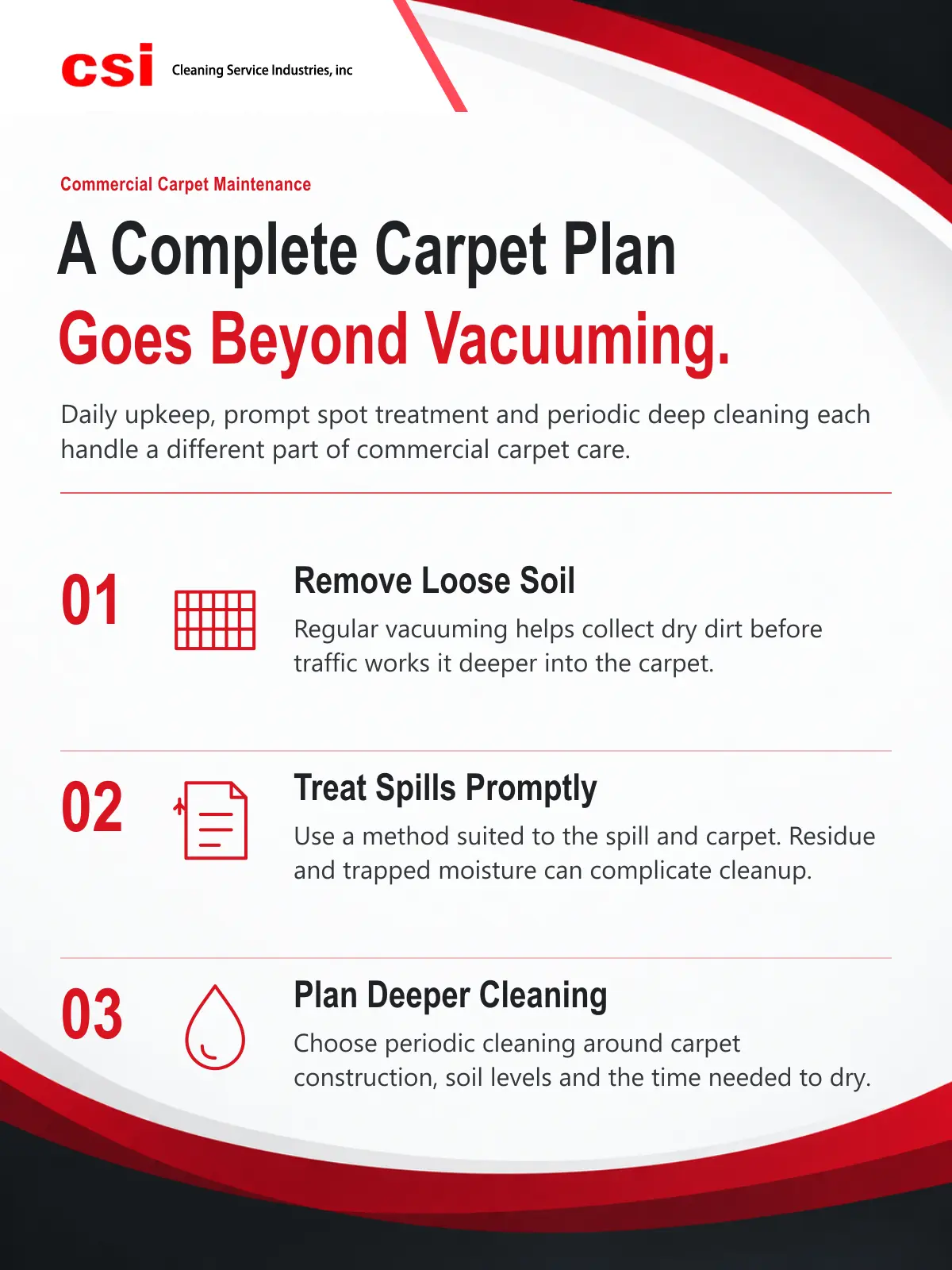
Give each part of carpet care a defined job
The practical distinction is between keeping up with ordinary soil, addressing a particular spot, and cleaning a larger affected area. The method and frequency should reflect the carpet, its condition, the manufacturer's guidance, and the office schedule.
Part of the plan | What it addresses | What it does not establish |
Routine vacuuming | Ongoing removal of dry soil and debris | That spills or persistent traffic-lane soil have been resolved. |
Targeted spotting | A specific spill or localized mark | That the surrounding carpet no longer needs periodic cleaning. |
Periodic carpet cleaning | Broader soil conditions using a suitable method | That permanent stains or worn fibers can be restored to new condition. |
The table is a way to define the work, not a prescription for one machine or chemical. A carpet tile system and an area rug may have different requirements, even when both are in the same office. Ask about the treatment selected for your actual floor covering and any limitations before the work begins. Brand names and technical terminology should not replace that explanation.
Plan for access and drying
Cleaning is easier to coordinate when the office identifies its constraints in advance. A reception area cannot necessarily be closed at the same time as a rarely used conference room. Let the cleaning team know when each space must reopen, what furniture can move, and whether deliveries or staff traffic will cross it. Confirm the expected return-to-use conditions for the chosen method rather than assume every carpet will dry within a universal number of hours.
Afterward, compare the areas that prompted the work: the entrance route, the pantry approach, or the recurring coffee spot. If a mark remains, ask whether it is residual soil, a stain, or wear before authorizing another treatment. Use that result to adjust the maintenance plan. Otherwise, the office can end up repeating the same service without learning why the same area remains disappointing.
Keep vacuuming, but stop asking it to remove every mark
Vacuuming belongs in your carpet-care routine. It should be supported by prompt spill attention and appropriate periodic cleaning, with realistic limits where staining or wear is permanent. That combination addresses why an office carpet can look tired even when the nightly visit is happening.
Contact CSI Cleaning about the traffic lanes or recurring spots in your office. Tell us what carpet you have, what has already been tried, and when the area can be made available. We can discuss carpet spotting or shampooing that fits the problem and a maintenance schedule that does not depend on vacuuming alone.
