
After-hours cleaning only works when the cleaning crew has the right access and the right limits. In an NYC office building, that usually means badges, keys, freight elevator rules, sign-in rules, alarm instructions, tenant suite boundaries, and restricted rooms. If those details stay informal, the crew may miss assigned areas, enter spaces they should avoid, or wait until morning staff complaints. A clear access plan protects the office, the building, the cleaning provider, and the people who expect the space to be ready the next morning. When searching for an office cleaning business in NY, you want to know how to weed out the best from the rest.
The practical question is not whether cleaners need access. They do. The better question is which areas they need to enter, when they need to enter them, which credentials they use, and who makes the decision when access fails. The contract should answer those questions before recurring service starts.
The Direct Answer
Access control should sit inside the cleaning scope, not in a separate verbal handoff. A badge or key tells a crew how to enter, but it does not tell them which rooms are approved, which doors are off limits, which routes are allowed, or who to contact when a space is locked. That gap creates most access-related cleaning complaints. Put the access rules in a written addendum tied to the recurring cleaning schedule.
That addendum should align with how the office operates at night. A Manhattan office with multiple tenant suites, security desks, freight elevators, alarmed doors, and sensitive rooms requires more detail than a small office with a single-entry point. The goal is not to make the process harder. The goal is to give the crew enough approved access to clean the assigned space without guessing.
What the Access Plan Should Cover
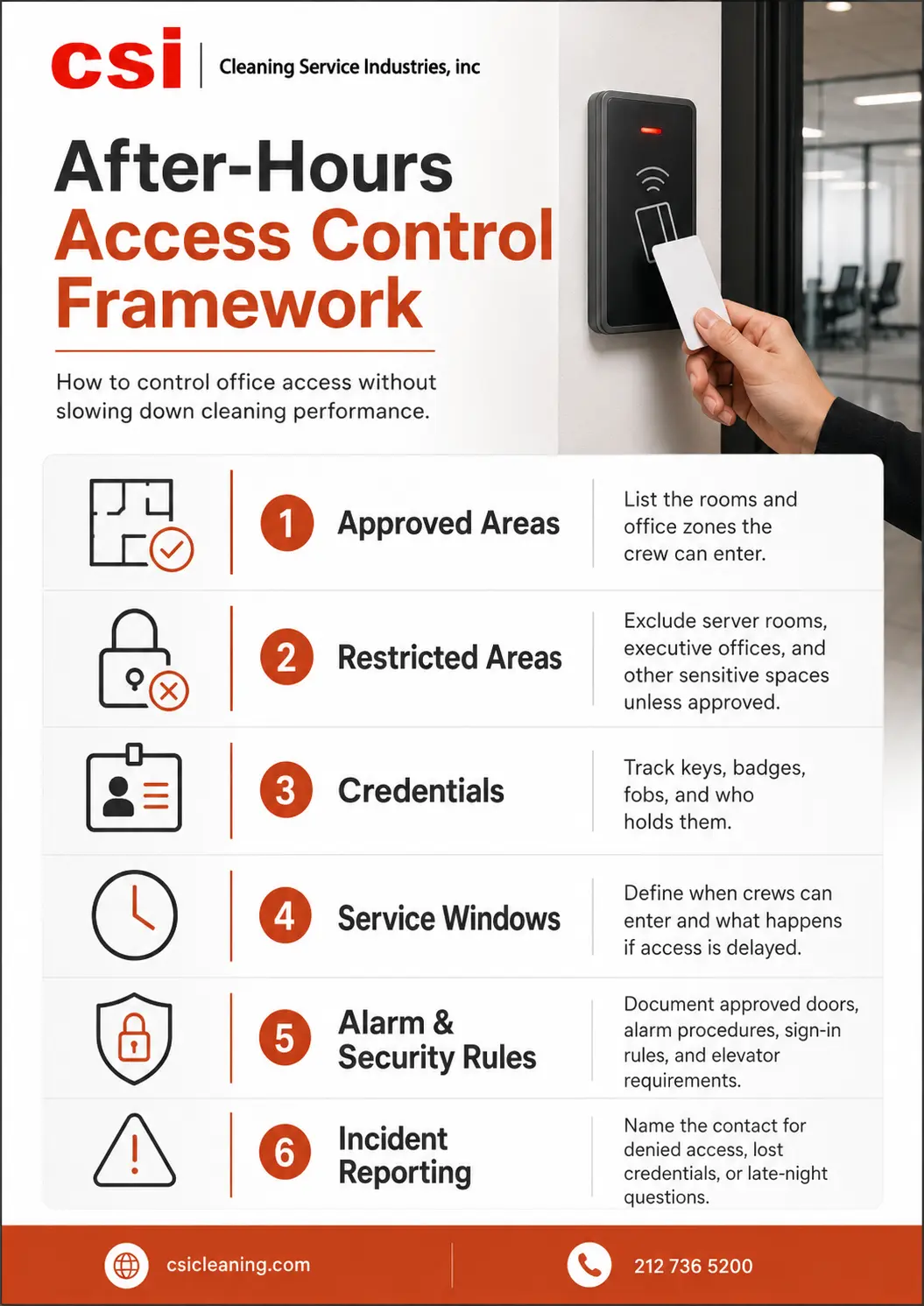
As a professional office cleaning business in NY, we’ve seen it all. A useful access plan connects each cleaning task to the room, route, credential, and time window needed to complete it. Restrooms, pantries, trash rooms, reception areas, conference rooms, corridors, and tenant suites each need clear rules. If an area gets cleaned every night, the crew needs an approved way to reach it every night. If an area is restricted, the plan should say so before the first shift.
- Approved rooms and zones for recurring cleaning
- Excluded rooms, including IT rooms, storage rooms, private offices, and tenant-controlled areas.
- Entry doors, approved routes, freight elevator rules, and sign-in requirements
- Badge, fob, key, and alarm-code custody rules
- Service windows for nightly, weekly, or special cleaning work.
- Rules for locked rooms, denied access, alarms, and blocked elevators.
- Contacts for building security, the client team, and the cleaning provider
- Incident reporting when accessing is permitted to prevent completion of assigned work.
These details prevent two common problems. The first problem is broad access without enough control, which creates risk around restricted spaces and lost property. The second problem is tight access with insufficient practical reach, which leads to missed restrooms, trash, pantries, or reception areas. A good access plan avoids both.
Common Access Problems and How to Fix Them
Access problems often look like quality problems at first. The restroom gets missed, trash remains in one suite, or fingerprints stay visible in reception. The crew may have failed to complete the task, but the real issue may be a locked corridor, unclear route, denied elevator access, or a restricted room rule no one wrote down. The fix should match the cause.
Access Issue |
What It Usually Means |
Best Next Step |
Restroom was missing behind a locked corridor. |
The scope exists, but the approved route or credential may be missing |
Add the approved route, credential, and escalation contact to the access plan |
Pantry residue repeats after tenant events. |
The service window may not match how the pantry gets used |
Adjust the schedule, event cleanup process, or work order timing |
Trash remains in one tenant suite. |
Suite access or tenant permission may be unclear |
Confirm tenant-controlled access in writing before assigning the area |
Crew avoids an alarmed side door. |
The alarm rule is not operational enough for the night crew |
Name the approved door, alarm contact, and failed-access process |
Fingerprints remain in reception. |
The area may sit outside the approved nightly route |
Add reception surfaces and glass touchpoints to the route map |
This type of review keeps the conversation practical. Instead of blaming the crew every time a task gets missed, the office manager and provider review whether the crew had the approved access needed to complete the task. That leads to better corrections and fewer repeat complaints.
Where Access Should Stop
The access plan should also say where the crew should not go. Sensitive rooms, IT closets, server rooms, storage rooms, executive offices, tenant-controlled spaces, alarmed doors, and any area outside the recurring cleaning scope should stay excluded unless written approval changes that rule. Verbal permission from someone nearby is not enough in many office settings. The contract should name who has authority to approve changes.
This boundary protects both sides. The client avoids unnecessary exposure to the property, in confidential rooms, and in the building's security areas. The cleaning provider avoids being blamed for areas they were never authorized to enter. The crew also has a clear rule to follow during the shift, rather than making a judgment call alone.
How Much Access Is Necessary?
The right access level depends on the actual cleaning scope. A provider should not receive broad access because the office wants convenience. The crew should receive the necessary access to complete approved recurring work, with controls over credentials, routes, and exceptions. That keeps cleaning performance and building security in balance.
Before after-hours service begins, the provider and office team should walk through the space or review a floor plan. They should identify the rooms on the nightly route, those cleaned less often, and those excluded from service. They should also identify which doors, elevators, and security checkpoints affect the route. This makes the contract easier to enforce later.
- Which rooms must be entered to complete nightly cleaning?
- Which rooms are excluded unless written approval changes the scope?
- Which route should the crew follow building sign-in?
- Which doors, elevators, or corridors are off limits?
- Who holds keys, badges, fobs, or alarm instructions?
- How are credentials returned, replaced, or disabled?
- What happens when a room is locked, or access is denied?
- Who receives the failed-access report before the next business day?
Office Cleaning NYC Plan
Access control is part of cleaning performance. A commercial office cleaning company cannot keep restrooms, pantries, trash areas, reception points, and shared spaces ready if the crew lacks approved access or clear limits. At the same time, broad access without written controls creates risk the office does not need. The best approach is a written access-control addendum tied directly to the cleaning scope.
Before recurring, service starts, document approved rooms, excluded spaces, routes, credentials, alarms, service windows, incident reporting, and escalation contacts. If the crew needs entry to complete assigned work, document the room, route, credential, time window, and contact path. If the area is sensitive, tenant-controlled, alarmed, or outside scope, exclude it or require separate written approval.
