A New York janitorial service plan should do more than name a few cleaning tasks. It should define which areas receive service, how often work happens, what access rules apply, and how the provider handles priority spaces. For different property types, such as offices, retail, or industrial spaces, the scope must be tailored to address unique cleaning priorities. CSI Cleaning helps New York businesses plan janitorial services around the real use of their space, including restrooms, floors, lobbies, shared areas, trash removal, and recurring cleaning needs.
A strong plan also gives both sides a practical way to measure the work. Without a defined scope, a business may expect one level of service while the cleaning team follows another. That often leads to frustration around restrooms, floors, entry areas, waste removal, and high-use spaces. A better janitorial plan connects the property’s traffic, hours, access rules, and service frequency to the work performed on each visit.
Why Janitorial Scope Matters Before Service Begins
The janitorial scope matters because commercial properties depend on shared spaces remaining clean, orderly, and ready for daily use. The plan should explain how the provider handles the areas people use most often, including entrances, passageways, restrooms, floors, waste areas, and common spaces. OSHA’s walking-working surface standard says employers must keep places of employment, passageways, storerooms, service rooms, and walking-working surfaces clean, orderly, and sanitary. For New York commercial properties, this underscores the need for planned floor care, entryway attention, spill awareness, and shared-area upkeep rather than loose verbal expectations.
Restrooms also need a clear place in the janitorial scope. OSHA states that employers must provide sanitary and immediately available toilet facilities for workers. That does not mean a cleaning provider controls every restroom-supply decision. Still, it does mean that restroom cleaning, supply coordination, trash removal, and reporting procedures should be discussed before service starts. If restrooms receive repeated complaints, the issue often stems from an unclear service frequency or a scope that does not match the building's use.
For many New York businesses, knowing which spaces are highest priority and which need service helps managers feel supported and reduces repeated follow-up on the same issues.
Core Areas a Janitorial Plan Should Cover
Most janitorial plans begin with the areas that affect the property's daily condition. Restrooms, floors, entryways, lobbies, breakrooms, shared corridors, waste areas, and common rooms usually need the clearest expectations. These spaces carry the highest shared-use burden because employees, tenants, visitors, customers, and vendors all pass through them. A plan should define what gets cleaned, how often it happens, and which conditions require added attention.
CDC facility guidance recommends cleaning high-touch surfaces regularly and cleaning other surfaces when they are visibly dirty. That guidance helps explain why a janitorial plan should not treat all surfaces the same. Door handles, counters, restroom fixtures, shared tables, elevator buttons, railings, and entry points often need more consistent attention than low-use areas. For janitorial service in New York, this supports a scope based on real traffic and use, not a flat checklist copied from another building.
| Plan Area | What to Define | Why It Matters |
| Restrooms | Fixture cleaning, counters, mirrors, floors, trash, supply coordination, and issue reporting | Restrooms create fast complaints when scope or frequency is unclear. |
| Floors and entryways | Sweeping, mopping, vacuuming, spot care, mats, and weather-related attention | Floors quickly show foot traffic, moisture, sidewalk debris, and spills. |
| Lobbies and shared areas | Floors, visible surfaces, touchpoints, seating areas, and waste removal | These areas shape how visitors, tenants, and customers judge the property |
| Waste and recycling | Collection points, frequency, bin locations, and overflow concerns | Waste problems become visible and disruptive when cadence is wrong |
| Breakrooms and shared rooms | Counters, tables, sinks, floors, trash, and touchpoints | Shared food and employee spaces need steady upkeep |
| Building access | Keys, alarms, elevators, service windows, security desks, and contact procedures | Access issues delay service and create confusion after hours. |
This table should act as a planning tool, not a final scope for every property. A small office suite, a retail space, and a managed commercial building will not need the same schedule. The crucial point is to define the scope before service begins. CSI Cleaning uses the quote conversation to understand which spaces matter most, how the property operates, and what recurring service should include.
How Cleaning Frequency Changes the Scope
Cleaning frequency changes the entire plan. A daily janitorial schedule may include restrooms, waste removal, floors, lobby attention, and high-use areas every visit. For larger or busier properties, more frequent cleaning ensures consistent cleanliness, while smaller spaces may require less frequent visits. A weekly schedule may need a tighter priority list because fewer visits leave less room for broad coverage. A custom schedule may give more attention to restrooms, entrances, and shared areas while placing lower-use spaces on a rotating basis.
The New York State Department of Health notes that public and private facilities should have cleaning and disinfection procedures, along with the supplies needed to support them. That point matters because frequency is part of the procedure, not an afterthought. A business should know which tasks occur each visit, which occur at set intervals, and which require special notice. This keeps the janitorial plan organized enough to support daily operations without turning every cleaning issue into a new request.
Commercial properties in New York also face practical timing issues. Service may need to occur before opening, after closing, during low-traffic windows, or in accordance with building rules. Weather can also change the needs of floors and entryways, especially when moisture, salt, and street debris enter the property. A clear schedule gives the cleaning team a better plan and gives the business a better way to set expectations.
What New York Properties Should Clarify Before Service Starts
Before service starts, a business should identify which areas need the most consistent attention. Restrooms, lobbies, entry floors, breakrooms, shared corridors, and waste areas are often the first places to review. The provider should also understand the business hours, building access, security procedures, elevator rules, parking, and the preferred point of contact. Incorporating specific access procedures, such as key protocols or alarm codes, ensures the cleaning team can operate smoothly after hours without delays or confusion.
The EPA’s Building Air Quality guide was created for building owners and facility managers and provides practical guidance on preventing, identifying, and resolving indoor air quality problems in public and commercial buildings. Cleaning does not replace ventilation or building maintenance, but it does play a role in the overall condition of the indoor environment. Dust, clutter, moisture tracked in from outside, product use, and poor coordination all affect how a space feels and functions. A janitorial plan should fit into the broader facility management rather than be a disconnected task list.
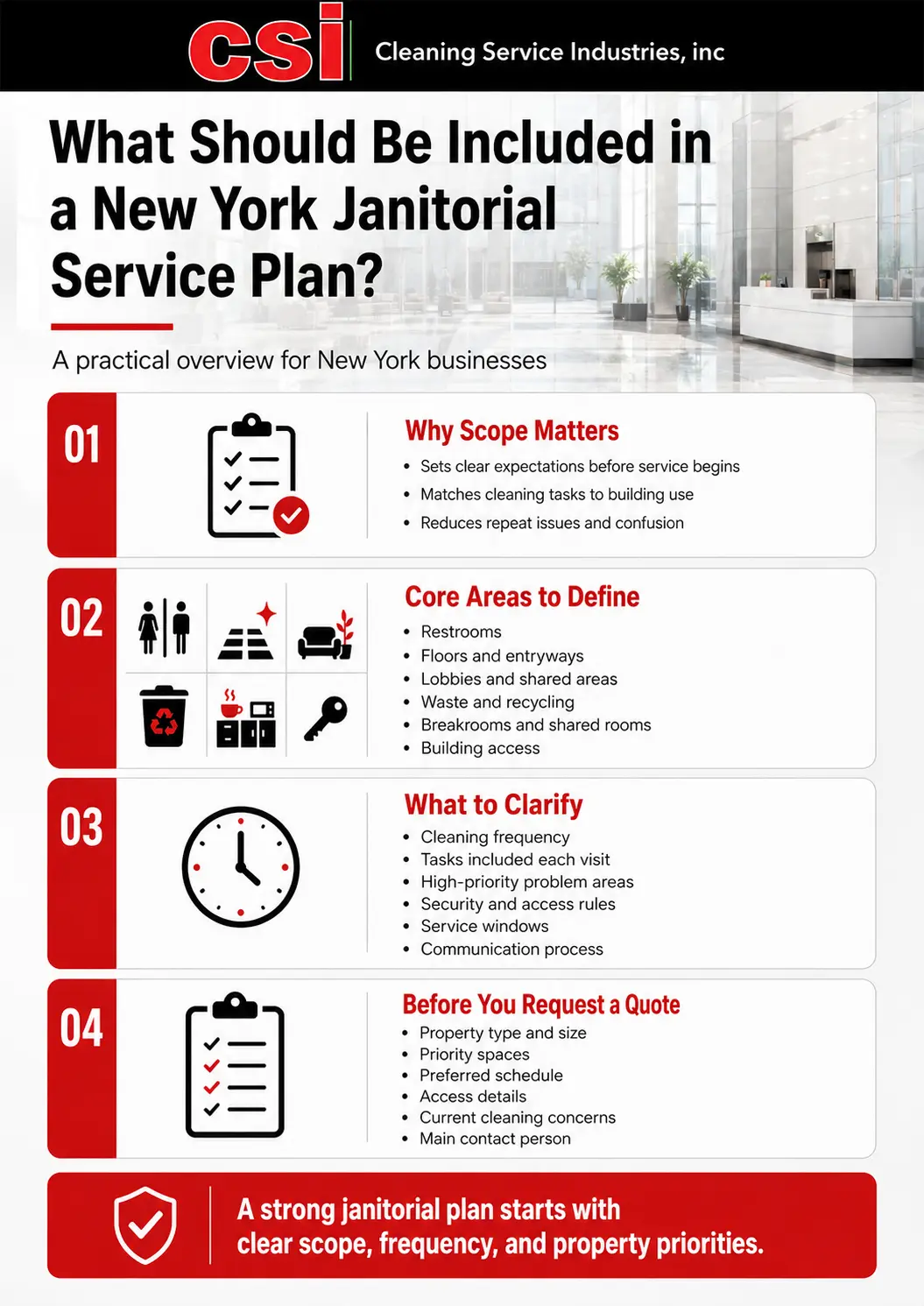
Clarify These Details Before Service Begins:
- Which restrooms, floors, lobbies, breakrooms, and shared areas are included
- Which tasks happen every visit, weekly, or on a rotating schedule
- Which areas create the most complaints or visible issues
- Which access rules apply for keys, alarms, elevators, parking, and security desks?
- Which service window works best for the property?
- Who receives service questions, updates, and issue reports?
- Supplies, restocking items, or facility details need coordination.
This planning step reduces confusion. It also helps the business compare providers using the same information, rather than comparing vague promises. A quote based on real scope, frequency, and access needs is more useful than one built around a generic service label. CSI Cleaning can use those details to discuss a janitorial plan that fits the property.
How CSI Cleaning Helps Build a Practical Janitorial Plan
CSI Cleaning provides New York businesses with a local provider with long-standing experience in office cleaning, janitorial services, and building maintenance. Cleaning Service Industries, Inc. opened in the early 1950s and has served NYC commercial clients for three generations. CSI’s site states that employees receive training for different corporate environments and that employees are bonded and covered by workers’ compensation, public liability, and property damage insurance. Those details matter because janitorial teams may work around tenant spaces, business equipment, public-facing areas, and after-hours access points.
A practical janitorial plan should make the property easier to manage. That means the service scope should be clear, the schedule should align with building use, and communication should not rely on guesswork. CSI Cleaning can discuss daily, alternate-day, weekly, biweekly, monthly, or custom janitorial services based on the company’s janitorial service page. That flexibility helps businesses build plans around traffic, budget, access, and priority areas instead of forcing a single schedule onto every property.
Related Reading
- Emergency Janitorial Services in Manhattan for Offices That Cannot Afford Downtime
- Janitorial Services NYC: Building a Scope That Protects Your Class A Office
- Meeting OSHA and CDC Cleaning Standards with Janitorial Services New York
- Commercial or Janitorial Cleaning Services NYC: Which is Right for Your Business?
- How to Clean Coffee Stains from Carpeting
