Corporate Facility Security and Evening Janitorial Vulnerabilities
You can control who enters your building during business hours, require employees to use badges, and restrict access to sensitive areas. But once the workday ends, those protections only matter if the people cleaning the facility are held to the same security standards. For a business owner, facility director, or building manager, the real concern is simple: who is inside the building after hours, where can they go, and can you verify their access if something goes wrong?
That is why security must be part of the decision when choosing janitorial services NY. Evening cleaning crews should never have broader, less accountable access than the employees who work in the building every day. A secure janitorial program limits after-hours access to what cleaners need and creates a reliable record of who entered protected areas, reducing physical security risk while supporting corporate compliance requirements.
Physical Security Science Background and Enterprise Compliance Frameworks
Physical access control within commercial office facilities is a mandatory regulatory vector governed by international information security frameworks. Under ISO/IEC 27001 (Annex A.11) and American Institute of Certified Public Accountants (AICPA) SOC 2 Type II criteria, organizations must prove that physical access to sensitive workspaces is strictly authorized, monitored, and audited. These rigorous frameworks explicitly hold corporate tenants legally liable for security breaches on their premises, whether an employee or a third-party janitorial contractor commits unauthorized viewing.
In high-stakes corporate sectors such as financial services, investment banking, and commercial litigation, executive desks frequently contain sensitive documents. When a janitorial vendor utilizes uncredentialed 1099 independent contractors, the corporate tenant cannot establish legal chain of custody or personnel attribution. If proprietary trade secrets are photographed on a personal smartphone or hardware is tampered with, forensic investigators have no reliable electronic record of which worker was in that specific room. Annual SOC 2 compliance audits regularly issue deficiency findings when third-party cleaning personnel are granted unmonitored, blanket access to enterprise office suites.
Mitigating physical access risk requires viewing evening janitorial personnel as an integral, accountable extension of the corporate security team. Individual electronic credentials and auditable shift logging satisfy third-party regulatory examiners while protecting corporate intellectual property. Structured physical security controls transform evening custodial operations into a secure, transparent business process.
Why Shared Master Keys and Propped Fire Doors Fail Building Safety Standards
Cleaning crews managing high-volume trash collection across multi-tenant commercial office buildings often take shortcuts to finish shifts faster. Relying on traditional physical brass master keys and wedging open fire-rated stairwell doors represents a dangerous security and life-safety failure.
These common operational shortcuts trigger catastrophic facility vulnerabilities across three primary pathways:
- Untraceable Master Key Duplication and Loss:Physical brass keys lack electronic audit trails and can be duplicated at retail kiosks without authorization; if an unvetted cleaner misplaces a master key ring, rekeying an entire commercial floor costs thousands of dollars.
- Severe Municipal Fire Code Violations from Propped Doors: Under NFPA 101 (Life Safety Code) and New York City Department of Buildings regulations, fire doors must remain closed and latched; wedging doors open to move trash hampers invalidates fire compartmentalization and incurs heavy municipal fines.
- Unauthorized Tailgating and Perimeter Breaches: Wedging exterior suite doors open allows external individuals wandering commercial lobbies to slip into private executive suites completely unmonitored, creating severe physical theft and espionage liabilities.
Attempting to solve after-hours access risks by requiring cleaners to sign manual paper visitor logs at security desks fails because log sheets lack real-time verification. Paper sign-in sheets provide zero visibility into which specific private offices were entered during an evening cleaning shift. Permanent facility protection requires electronic access badges and enforced physical zoning architectures.
Access Architecture Engineering: Three-Tier Facility Zoning and RFID Tracking
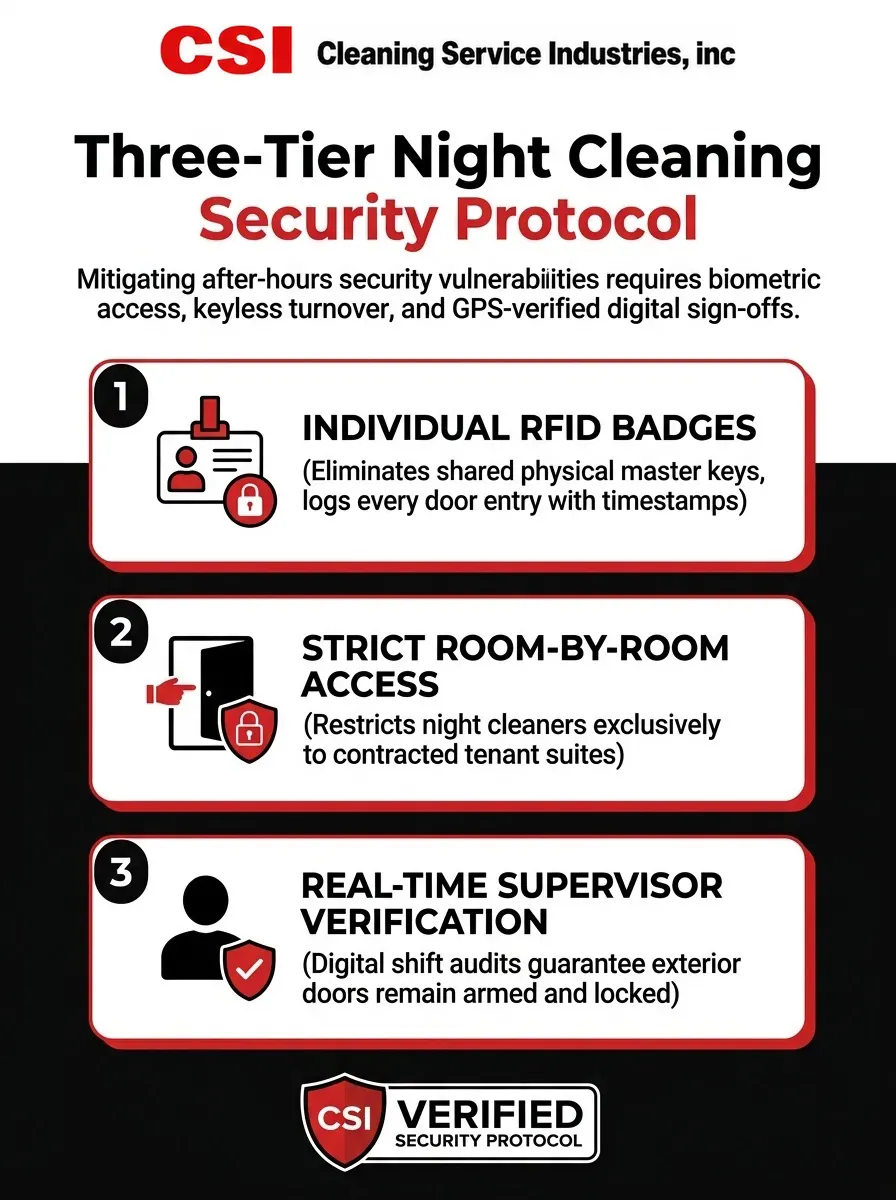
Eliminating after-hours security vulnerabilities requires establishing a disciplined Three-Tier Physical Zoning Plan across the corporate footprint. Under this access architecture, commercial workspaces are segmented into distinct operational security zones with strictly defined cleaning protocols. Zone 1 encompasses general public circulation spaces—such as reception lobbies, central hallways, restrooms, and kitchen breakrooms—which are serviced nightly without security restrictions.
Zone 2 comprises open-plan cubicle floors and standard conference rooms, where evening vacuuming, surface sanitization, and waste collection occur under enforced Clean Desk Policies. All tenant staff must lock sensitive printed files and laptops in secure credenzas before departing, ensuring cleaners encounter only clear desktop surfaces. Zone 3 represents high-security environments, including executive boardrooms, legal litigation war rooms, and dedicated IT server network closets. Cleaners are strictly prohibited from independent unmonitored entry into Zone 3; these sensitive areas are serviced exclusively during daytime business hours or under the continuous physical escort of a facility security officer.
All cleaning technicians must also be issued individual RFID electronic access badges programmed with time-bound access windows that match scheduled shift hours. Every badge swipe creates an immutable electronic timestamp recorded within the building's central security database, providing complete personnel attribution. After the evening shift, the on-site janitorial supervisor conducts a comprehensive perimeter inspection, verifying that all fire doors are latched, private offices are secured, and intruder alarms are armed before final lockdown.
Comparative Analysis of Janitorial Security Architectures
Security Parameter | Conventional Janitorial Contractors | CSI Secure Janitorial Operations | Enterprise Risk Mitigation Value |
Labor Screening & Vetting | Unvetted 1099 independent contractors; rotating crews | 100% direct W-2 employees; background-checked | Eliminates anonymous labor; ensures legal vetting |
Access Credential Mechanism | Shared physical brass keys with zero audit logging | Individualized RFID badges with real-time logging | Provides precise electronic timestamp attribution |
Facility Zoning Enforcement | Blanket access to entire facility including server rooms | Strict three-tier zoning; restricted IT zones locked | Prevents unauthorized access to sensitive data |
Perimeter Door Management | Propping fire doors open during trash collection | Strict zero-propping policy; 100% latched doors | Maintains NFPA fire safety; stops tailgating |
Shift Closeout Protocol | Unescorted cleaners depart when tasks are finished | Supervisor-verified lockup checklist & alarm arming | Guarantees complete perimeter security at night |
Field Security Diagnostic Protocol for Corporate Janitorial Services
Verifying janitorial security compliance and confirming physical access controls requires structured diagnostic auditing. Corporate security directors and facility managers deploy systematic audits to validate after-hours operational integrity.
A comprehensive facility security diagnostic protocol incorporates three standardized technical benchmarks.
- Electronic Access Control Badge Log Auditing: Security analysts review electronic access logs monthly, cross-referencing cleaner badge timestamps against scheduled shift rosters to detect unauthorized off-hours access or badge sharing.
- Physical Perimeter Latch and NFPA Egress Sweeps: Facility managers conduct unannounced evening inspections to verify that all fire-rated stairwell doors, emergency exits, and tenant suite perimeters remain fully closed, latched, and unblocked.
- Clean Desk and High-Security Zone Compliance Audits: Supervisors conduct random visual audits of Zone 2 and Zone 3 spaces during evening cleaning shifts, verifying that all IT network closets remain locked and confidential executive files are securely stowed.
Standardized security audits ensure third-party cleaning services adhere strictly to corporate security governance. Documenting electronic badge logs and perimeter latch checks satisfies annual SOC 2 Type II and ISO 27001 physical security audits. Enterprise leadership receives certified operational proof that corporate facilities remain immaculate, compliant, and completely secure.
Enterprise Security and Janitorial Excellence with CSI Cleaning
Maintaining a pristine corporate facility in New York City must never compromise physical security or regulatory compliance. Enforcing individualized RFID badge access, deploying background-checked W-2 personnel, and implementing strict three-tier physical zoning eliminates after-hours security vulnerabilities. Aligning janitorial operations with SOC 2 and ISO 27001 security standards protects proprietary data while delivering flawless office cleanliness.
Related Reading
- Janitorial Services NY: Building a Cleaning Plan That Fits Your Office
- Emergency Janitorial Services in Manhattan for Offices That Cannot Afford Downtime
- Janitorial Services NYC: Building a Scope That Protects Your Class A Office
- Meeting OSHA and CDC Cleaning Standards with Janitorial Services New York
- Commercial or Janitorial Cleaning Services NYC: Which is Right for Your Business?
